Most vehicle games are about the car. Project Ignition is about the objective — and three decades of design history explain why that single decision changes everything.
Most vehicle-combat games are, at heart, about the vehicle. Project Ignition is about the objective — and that single decision reshapes every match. To understand why, it helps to look at where vehicular combat came from, and where team games went.
A genre with a ghost and a giant
Vehicular combat has a ghost and a giant. The ghost is Twisted Metal, which effectively invented the genre in 1995 — cars plus weapons plus last-driver-standing — and, thirty years later, still 'has no rival and no peer' as a series. The giant is Rocket League, which proved that objective-based car combat could scale to a mass audience, peaking near 100 million monthly players after it went free-to-play in 2020.
peak monthly players for Rocket League after going free-to-play (third-party estimates, 2021)
The lesson we took from both: the fantasy of driving a war machine is timeless, but what makes it a live game people return to is a clear, repeatable objective — not just a kill count.
One resource: fuel
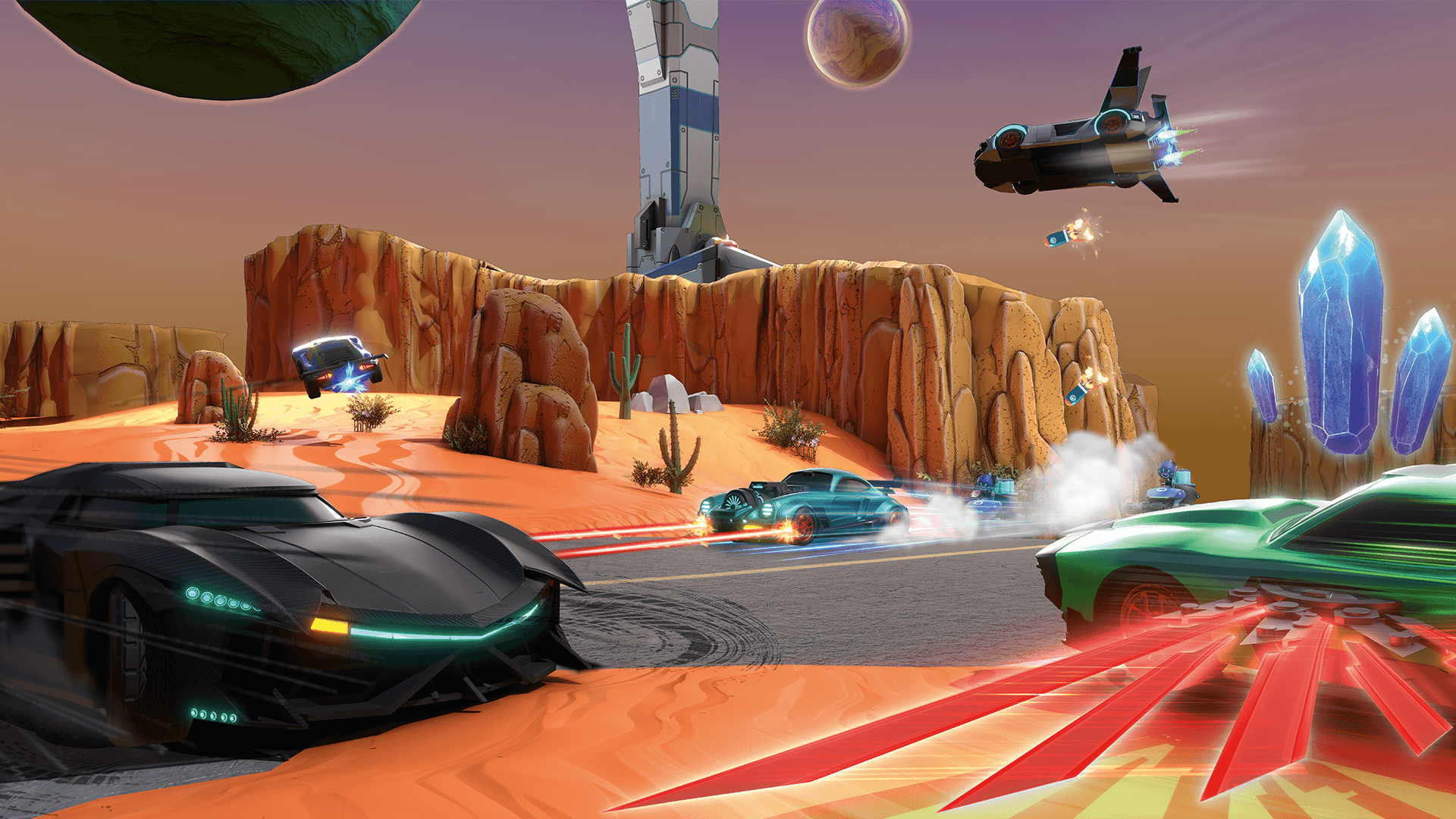
So we built Ignition around one. Each match drops two teams into a warzone built around a single resource: fuel. Bot minions roam the field extracting it, delivering it near your base — but it isn't yours until you deposit it. And nothing stops the enemy from taking it first. Steal from their reserves. Intercept their carriers. Defend your own stockpile. Fill your tank and your base mobilizes toward the center — first team to push theirs to the middle wins the war.
Steal the fuel. Move the base. Win the war.
Why 'objective-first' is a retention mechanic
There's a reason the best live team games are built around moving objectives rather than raw elimination. Look at Overwatch's payload: it only advances when attackers are near it, moves faster with more of them, and even heals its escorts. That math isn't decoration — it's engineered to force a team to group, coordinate, and create readable moments of tension. Objectives manufacture the repeatable, legible team goals that seasons, challenges and ranked ladders are built on.
The fuel war is our version of that idea, tuned for cars. Every match is a negotiation between offense and defense, between greed and patience — do you push your fuel to the center now, or raid theirs first? It creates stories, and stories are what bring players back.
Five classes, infinite strategy
No single vehicle wins alone. Victory demands the right squad composition — knowing when to attack, when to defend, and when to steal:
- —Specter — slips through enemy lines to raid fuel undetected
- —Heavy — bulldozes everything in its path to defend the convoy
- —Airtime — launches over obstacles for surprise aerial flanks
- —Sidewinder — a rapid drift-flanker built to ambush and disrupt
- —Blackout — EMP blasts and jammers that kill enemy radar
It's a war of strategy, speed, and survival — the timeless fantasy of Twisted Metal, structured with the objective discipline that made Rocket League and Overwatch live for years. It's coming to Steam. Fuel up. Fight on.
Sources: Wikipedia/Inverse/GamesRadar (Twisted Metal, Rocket League); Overwatch Wiki (payload mechanics); Rocket League MAU figures are third-party estimates.
Dirtcube Interactive — Inspire. Create. Entertain.
See Our Products